
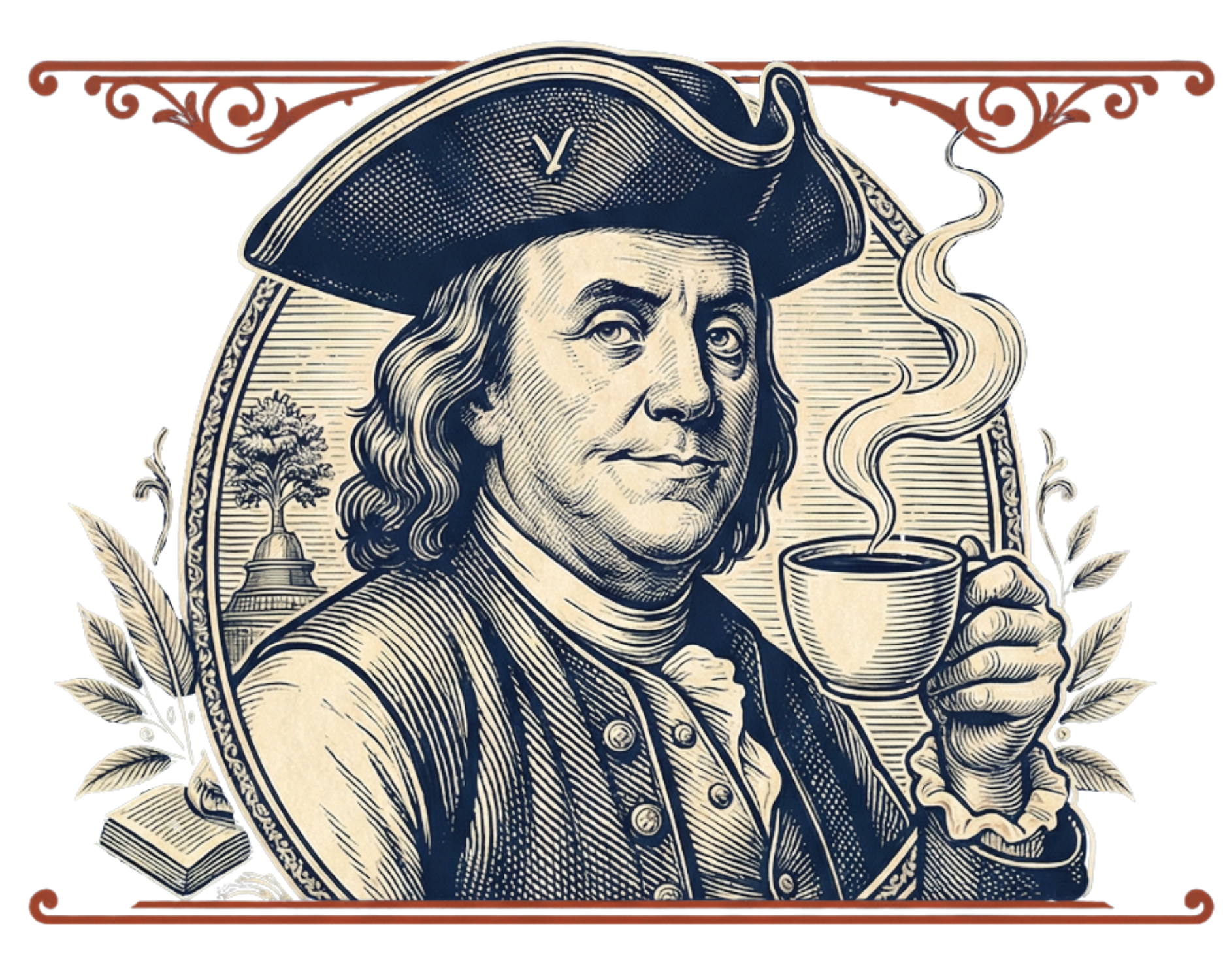
Benjamin Franklin
Benjamin Franklin was born the tenth and final son of a soap and candle maker in Boston, the fifteenth of seventeen children, and he became, through nothing but intellect, industry, and an absolute refusal to be limited by his origins, one of the most consequential figures of the 18th century.
He co-founded the first public lending library in America, in Philadelphia in 1731, because he believed that access to knowledge should not be a privilege of the wealthy. He co-founded the first volunteer fire department. He co-founded Pennsylvania Hospital, the first public hospital in the American colonies. He invented the lightning rod, bifocals, and the flexible urinary catheter. He mapped the Gulf Stream. He established the postal system.
Politically, he was a deist who distrusted organized religion and believed that the measure of a moral life was its social utility. He was a religious skeptic who considered virtue and civic service to be their own justification. Later in life, he became an active abolitionist, presiding over the Pennsylvania Abolition Society and submitting one of the first anti-slavery petitions to Congress in 1790.
At the Constitutional Convention in 1787, he was 81 years old, so infirm that he had to be carried to sessions in a sedan chair. He stayed for all of it anyway, because the work wasn't done.
Franklin believed in merit over privilege, in reason over dogma, in humor as a tool for truth-telling, and in the idea that the purpose of a government was to make the lives of its citizens better. He would have had a lot to say about the current moment.